Watch me...
When I'm elated, I explode.
When I'm livid, I implode.
When I'm afraid, I collapse.
When I'm justified, I inflate.
When I'm sensuous, I dance.
When I'm bored, I pace.
When I'm in love, I make love.
When I love, I embrace.
Saying what I mean is harder than writing it to you,
so let me move around you.
Wednesday, September 29, 2010


Something in the Water
I both love and am terrified of the ocean. Everyday people ask me, "Have you gone for a swim yet?" and I'm afraid to admit that I'm scared of the water, that when I can't touch the sandy bottom anymore I panic and I'm sure I will drown. Not seeing the bottom, feeling my toes wrap and twist in deep beds of kelp, being pulled unaware further out to sea until I'm within the grips of something much more powerful than my sense of control. All of this frightens me.
On the way home from work, locals stop to take a swim to wash the dirt and stress of the office out of them before going home. You leave it at the shore and let the ocean demolish it. Just like leaving your shoes at the door, you leave your angst and worry at the threshold between land and sea. I go there for clarity. I go for peace. I go to remember things. I find that now when I approach the edge and let the tide swirl around my ankles I am overcome with the need to strip and jump in. I mostly watch and wait. I see other swimmers throw down their flip flops and shirts, and walk with familiarity and grace into the waves. They are going into the womb. They are going into the Mother to lie flat on their backs and watch the clouds pass over, to be cradled between land and sea and sea and sky. They dolphin flip down deep into the water and come up with treasures from the bottom. They swim dozens of yards out to sea and then they pray or they scream or they cry or they laugh. They just... release. And then they go home.
People tell me, I must swim at least once everyday. The island is a waste unless I do. So when I'm up to it, or when I'm curious about what the water will make me feel today, I go to the shore and remember Ocean Beach with my mom. When I was little we would walk next to the surf on foggy days. My mom liked teasing me by running closer and closer to the waves until the rolled cuffs at her knees were in the water and then run back. I became so frightened once that I started crying. She couldn't swim and I was too afraid of the water to go out there after her. I was so afraid to have her out of my grasp, to give her over to something so unpredictable. She was teaching me how to lose control.
I look at the waves now, knowing that JAWS has already begun to return to the north shore. JAWS is a swell of water that makes the waves larger than the Mavericks at Half Moon Bay. JAWS is what you see when these waves curl over you 50 feet in the air. It has already started to change the anatomy of the local beach by shifting the sand up closer to the trees. The waves are much bigger and much closer. Farther out you can see even larger ones breaking where the ocean bottom drops down two thousand feet. The rip tide and the undertow are the strongest they've been since I arrived and are getting stronger. No one is swimming. Only bodysurfers and boogie boarders bob between the crests. The surfers will come when the waves are even bigger. I watch in the tide, sinking in the sand. It's not a good idea. But I still want to and I might. I'll keep watching. I'll keep waiting. Slowly i'll find ease in giving myself over to everything less predictable than myself.

Friday, September 17, 2010
Abundance in Maui
 |
| The Garden |

The living is simple here, and yet it is abundant! The garden is overflowing with spinach, kale, basil, onions, lettuce, papayas, peppers, mint, avocado, lilikoi and more. Everyday I find a new musical instrument hidden in an outdoor shed, under a couch, on the bottom shelf of a bookshelf. When I moved into my room I found a hammer dulcimer under my bed! If you know anything about me, you know that this is personal heaven for me. Outside of the house I live in (there are two houses with several rooms and a few studio units) there is a car port area made for creating and baking pottery. In front there is a large porch with Christmas lights hanging all around. Shell dangly bits and wind chimes hang everywhere among dozens of massive spider webs that no one will knock down. Buddha and Krishna and Shakti statues sit at the bases of trees and on the banisters of the porch with offerings of beads and quartzes and seashells beneath them. There is a cotton tree. There is a tree that looks like a dancer, and there is a tree that has been carved into a totem pole

There are animals everywhere. We had several chickens when I first moved here. There was Sita and her 13 chicks which the mongoose have trimmed down to a slim five. Today they were taken to a bird sanctuary because we couldn't keep them out of the garden but caging them wasn't an option. There's a rabbit, and several cats. One follows me around like a dog. There are the wild chickens that come in early in the morning which I have to chase off the property most mornings. There are the dogs that chase them. There are toads, and geckos, and lizards, and cane spiders. There are giant-leafed plants with leaves so big you think you could just sprawl out on top of them.
 |
| New Life |
 |
| Mama Sita and Five |
Saturday, July 18, 2009
Grandaddy's Hands
My mom wrote this poem as a type of elegy after her father passed away. I wanted to put it up here as a remembrance for him and because it is a really beautiful poem.
Daddy's Hands
baseball mitt palms
and plump sausage fingers
dirtied and hardened by
construction labor;
a hard day's work
born of necessity
extentions of a creative mind -
for crafts, repairs and gardens that
needed plowing and tending
rarely raised in anger;
not for disciplining,
those hands
In loving memory:
George Ashley (1930 - 2009)
baseball mitt palms
and plump sausage fingers
dirtied and hardened by
construction labor;
a hard day's work
born of necessity
extentions of a creative mind -
for crafts, repairs and gardens that
needed plowing and tending
rarely raised in anger;
not for disciplining,
those hands
In loving memory:
George Ashley (1930 - 2009)
Copyright Brenda DeRamus 2009
Tuesday, April 28, 2009
Michael Cunningham Visits The University of Puget Sound
 I ended last week by attending a performance of Michael Cunningham, author of The Hours, reading the prologue of the acclaimed novel to the music that inspired its creation. Cunningham thrust us into the experience of listening to literature to a soundtrack. Mozart and Schubert best captured the general tone of what he thought his novel would be. He described listening to the classical compositions over and over again until the lives of his both fictive and historical characters came into fruition. So he read to us his written incarnation of Virginia Woolf while the Northwest Sinfonietta String Quartet played Schubert's "Death and the Maiden" live to the cadence of his voice. To sum it all up, he completed his reading of the prologue, the intimate scene depicting his vision of Virginia Woolf's suicide, to the music from the motion picture composed by Philip Glass. From second row center, I closed my eyes and listened to Mrs. Woolf being engulfed by eddies of water through the unsettling trills of two violins, the deep current of the pulsating bass and the swift arpeggios of the piano that insistently pulled her along the river bottom. That night I got a book signed, purchased my first Philip Glass album, went home, listened and read.
Cunningham did me a favor really. I realize now how to use music to benefit my writing. Picking a tone is like picking the color of a certain day or feeling. Now something that seemed intrusive to my writing process can take part in getting some of those blasted words down onto some paper, or into the screen, for a change. As a musician myself I can only leap for joy at the joining of these two art forms, and I have to say, I've come away from it all with some new ideas.
Friday, April 3, 2009
Sephia Day
 The day Grandma Banks died, people congregated in one space, brought dining chairs into the living room, sat on the floor, laid on each others' laps, laughed and quietly brushed at watery eyes for the first time in years. They let their hair down again. They loved and remembered. She had passed away and so we all came together, out of the woodwork, for her. The cousins I had grown up with, who I had not seen for over seven years were suddenly all together as familiar strangers and adults. I was ecstatic and solemn, feelings so far apart that they hardly made any sense at all.
I can't really describe what it was like, experiencing death among loved ones for the first time, finally grasping that my step-mother's family was mine too, had been all along, and being sad too. But that day I remember in sephia because it was like living in a memory. Because my emotions were polar opposites, black and white, like an old photograph. Then and now. Before and after. We were girls in white dresses and lace socks, we are grown women, independent, working, maybe in love, and confused because we are still young. And one day we'll be gone too. The sensation is too fresh to get now, but sephia describes it and makes a home of it for me.

In Loving Memory of Idella Cavit Banks (May 16, 1925 - March 19, 2009).
Tuesday, March 10, 2009
Hoshi Kashiwagi and American Autobiography
Today, memoirist Hoshi Kashiwagi spoke to my Genre: Nonfiction class about autobiography, family, secrets, and what it means to own your own story. But we can't really own our own stories can we? As I "write down my own bones" I find that every single one of them has touched or is attached deeply to someone else. While Dr. Kashiwagi talked about Japanese internment during the second World War, the useless feeling to which he succumbed while imprisoned, "no-no boys," half-owned half memories, and theatre art in a veritable jail, I thought about my mother, half siblings, our fathers, Alabama, and the Golden Gate Bridge. Can I morally tell my story when more than half of it belongs to someone else? Memoirists debate over the need to be true to their familial allegiances and there indescribable need to tell a true story, their story. Some have insurance to deal with the discrepancies, some take their chances, others have severed ties. There is no easy answer, no way to compromise desire with sometimes flimsy obligations. So I will try to write the truth. I will try not to hurt your feelings. I will try not to hurt my own feelings. But tell the truth, tell the truth.

In the spirit of autobiography, which I've been working with a lot of lately, I picked a neat prompt to motivate some writing. In a week or so I'll post my own response to the prompt. Please feel free to post your own response in a comment which I can put up if you like, or just share your experience in a comment if you decide to write something. (I found this prompt in the article "Writing the Memoir: A Practical Guide to the Craft, the Personal Challenges, the Ethical Dilemmas of Writing Your True Stories," by Judith Barrington.)
Pick a day or part of a day from your memory and assign it a color. Describe that time, returning to, and developing, the theme of color and showing the reader why you think of it as a "yellow day" or a "purple afternoon."
Remember to pick a strong memory...
Swimming in the American: A Memoir and Selected Writings
By Hoshi Kashiwagi
Legally Own Your Work: How to Copyright Your Stuff
 I've put some poetry on here but stories are my thing. I'd like to put some up but the main concern holding me back is that this is a public venue and there is no legal protection of my work. I asked a professor of mine, Hans Ostrom, who regularly puts his poetry in his blog, about the copyrighting process and his peace of mind. I thought I should put what I learned regarding the copyright process up here for the benefit of other creative writers.
There are two ways to go about copyrighting your work: Go through the U.S. Government. There is always a fee if you do it this way. You can go to this site and check it out: http://www.copyright.gov/. Here you can find everything from long winded descriptions of legalities to hokey anime animations that break down the whole process for you. Doing it this way is expensive, especially if you have a lot of pieces that are not part of a larger collection.
There is a much simpler and cheaper way to go about this that will cost only as much as your work's weight in postage stamps. Mail the thing to yourself. Just make sure that it has a clear date stamped on the envelope. When you receive your present in the mail, don't open it. Keep it as proof that you have in fact copyrighted your work. You can mail novels, stories and poetry to yourself individually or together as a large collection. It's really up to you and what your own ideas are about how your work should be published. For instance, if you send a collection of short stories to yourself but a year later add two more stories to that collection to make a new edition, the new stories are not copyrighted. To be considered a part of the whole collection you would have to re-mail the collection to yourself with the new stories included. The new date stamp is the new copyright date. Of course, this information is heavily informal and should be researched again before you consider copyrighting. Here is an interesting site that debates the issue (because it is an issue): http://www.copyrightauthority.com/poor-mans-copyright. Copyrighting your work protects your work and makes sure that you lawfully receive credit whenever someone other than yourself publishes it. Which ever method you use, make sure you understand all of the laws associated with that method and above all, make sure you are comfortable with using that method for something you worked hard to create.
Monday, March 2, 2009
Billie Holiday's "Strange Fruit"
 Ben tipped me off to this song. Billie Holiday, otherwise known as Lady Day, adapted this song from a poem and melody written by an English teacher named Abel Meeropol who wanted to address the southern atrocity, lynching. Holiday performed this at the risk of losing her career. Her music was a seminal contribution to the jazz musical surge towards the end of the Harlem Renaissance. It popularized the intimacy that is felt while listening to this song, watching her visage, and reading her words. Read the lyrics first, then listen, then read and listen at the same time.
Strange Fruit
Southern trees bear strange fruit,
Blood on the leaves and blood at the root,
Black bodies swinging in the southern breeze,
Strange fruit hanging from the poplar trees.
Blood on the leaves and blood at the root,
Black bodies swinging in the southern breeze,
Strange fruit hanging from the poplar trees.

Pastoral scene of the gallant south,
The bulging eyes and the twisted mouth,
Scent of magnolias, sweet and fresh,
Then the sudden smell of burning flesh.
The bulging eyes and the twisted mouth,
Scent of magnolias, sweet and fresh,
Then the sudden smell of burning flesh.
Here is fruit for the crows to pluck,
For the rain to gather, for the wind to suck,
For the sun to rot, for the trees to drop,
Here is a strange and bitter crop.
For the rain to gather, for the wind to suck,
For the sun to rot, for the trees to drop,
Here is a strange and bitter crop.
Some things to think about:
What does Holiday do differently with her voice? Her face? What effect does it have on you as you watch her?
Why does Meeropol use the poplar tree as a vehicle to portray lynching?
What is significant about the scent of magnolias?
Billie Holiday (April 7, 1915 – July 17, 1959)
Abel Meeropol (February 10, 1903 - October 30, 1986)
Thanks for that awesome observation Ben.
Why does Meeropol use the poplar tree as a vehicle to portray lynching?
What is significant about the scent of magnolias?
Billie Holiday (April 7, 1915 – July 17, 1959)
Abel Meeropol (February 10, 1903 - October 30, 1986)
Thanks for that awesome observation Ben.
Saturday, February 21, 2009
Two Good Watches for Black History Month
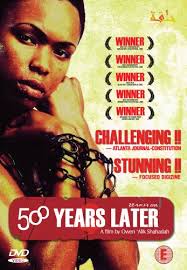 "500 Years Later" is a great documentary to watch for Black History Month. Instead of just focusing on blacks in the United States, historians and professors, students and professionals, follow Africans through the centuries all over the world starting from the slave trade. Blacks are not termed as African American or African English or African Belizean, but together as African descendants. Through watching this I learned that many of the race issues that African Americans face are faced by the millions of blacks around the world who have descended from enslaved ancestors. It brings up issues about the legacy of slavery, the absence of African history/philosophy/art/spirituality in our history books, and internalized racism. The documentary is very much supportive of the pan-africanist philosophy, which was a new take for me on how to approach black identity in a white world, but it broadened my perspective about who I have been as an African American and who I want to be as an African American.
 "The Color of Fear" is a dialogue project between eight American males - black, white, Asian, and Latino - specifically discussing racism in the United States. This documentary is not about black history or Black History Month but serves as a good follow up to "500 Years Later," which left me asking many more questions about race relations in the U.S.
This film addresses and asks questions such as:
What does it mean to be white vs. a person of color in the United States?
What does it mean to be American?
What is the definition of racism?
Is there a solution to contemporary racism?
The conversation between these men forces us to redefine racism as we know it and confront stereotypes that we all have about others and even ourselves. This is a must see for every American.
Below is a trailer to the film.
Wednesday, February 18, 2009
On Slave Narratives and Kate McCafferty's "Testimony of an Irish Slave Girl"
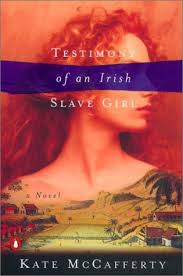
I just finished reading Kate McCafferty's Testimony of an Irish Slave Girl, a fictional slave narrative about an Irish child forced into slavery by her English overlords. After reading the autobiographical narratives Incidents in the Life of a Slave Girl by Harriet Jacobs and Narrative of the Life of Frederick Douglass by Frederick Douglass for two classes that I am currently taking, I thought it would be interesting to read a slave narrative from the seldom-studied point of view of a white European slave, captured, put on a ship, and forced into indentured servitude in much the same way as hundreds of thousands of Africans were. The crucial difference? The possibility of freedom. Although this work is fictional, I thought it captured the realities of what it may have been like to be a female Irish slave in the caribbean very well.
On the tiny caribbean island of Barbados during the mid 1600's, Cot Daley faces many of the same struggles that a black slave woman would have as she copes with coercion into the role of breeder and mate, while at the same time she superficially benefits by being one step higher on the social hierarchical ladder than the Africans by whose sides she works: if she behaves, she can eventually go home. While this possibility remains a ray of hope for Cot, she must still confront the alienation that comes with bearing the same shade of skin as her captors and the captors of the entire slave community. Her tale is not only one of survival, but one of trying to find a place and home within a community that is resistant to accepting her as one of their own.
Friday, February 13, 2009
"How to Write Good"

Here is a list of some rules about fiction writing and writing in general. I don't know where this came from, but some items on this list are pulled from William Safire's Rules for Writers. Some I agree with and some I don't. Most make me laugh.
"1. Avoid alliteration. Always.
2. Never use a long word when a diminutive one will do.
3. Employ the vernacular.
4. Eschew ampersands & abbreviations, etc.
5. Parenthetical remarks (however relevant) are unnecessary.
6. Remember to never split an infinitive.
7. Contractions aren't necessary.
8. Foreign words and phrases are not apropos.
9. One should never generalize.
10. Eliminate quotations. As Ralph Waldo Emerson said, "I hate quotations. Tell me what you know."
11. Comparisons are as bad as cliches.
12. Don't be redundant; don't use more words than necessary; it's highly superfluous.
13. Be more or less specific.
14. Understatement is always best.
15. One-word sentences? Eliminate.
16. Analogies in writing are like feathers on a snake.
17. The passive voice is to be avoided.
18. Go around the barn at high noon to avoid colloquialisms.
19. Even if a mixed metaphor sings, it should be derailed.
20. Who needs rhetorical questions?
21. Exaggeration is a billion times worse than understatement.
22. Don't never use a double negation.
23. capitalize every sentence and remember always end it with point
24. Do not put statements in the negative form.
25. Verbs have to agree with their subjects.
26. Proofread carefully to see if you words out.
27. If you reread your work, you can find on rereading a great deal of repetition can be avoided by rereading and editing.
28. A writer must not shift your point of view.
29. And don't start a sentence with a conjunction. (Remember, too, a preposition is a terrible word to end a sentence with.)
30. Don't overuse exclamation marks!!
31. Place pronouns as close as possible, especially in long sentences, as of 10 or more words, to the irantecedents.
32. Writing carefully, dangling participles must be avoided.
33. If any word is improper at the end of a sentence, a linking verb is.
34. Take the bull by the hand and avoid mixing metaphors.
35. Avoid trendy locutions that sound flaky.
36. Everyone should be careful to use a singular pronoun with singular nouns in their writing.
37. Always pick on the correct idiom.
38. The adverb always follows the verb.
39. Last but not least, avoid cliches like the plague; They're old hat; seek viable alternatives."
Wednesday, February 11, 2009
An Opportunity, A Tribute

Wilmott Proviso Ragsdale
(August 19, 1911 - January 16, 2009)
I wrote this essay in response to a contest prompt. The one who can best explain their reasons for wanting this prize (a 10 day trip to Africa with New York Times writer Nicholas Kristof) is the winner. It seemed the proper time to mull through some feelings about the recent death of an elderly friend of mine, Rags.
"I used to drive an old man around. He was modest and simple. He wouldn't step outside without a cap, a pair of loafers, and a kerchief in his breast pocket. He was that kind of an old man. Always put together, always a gentleman, and always abundantly kind. Wherever I drove him, somebody inevitably knew him; sometimes personally or simply as the great writer, journalist, and teacher that he was. While I drove or walked with him through grocery aisles he told me stories. He told me that his first car was a Ford Model T and that he remembered San Francisco, my hometown, before there was a Golden Gate Bridge. He told me what it was like working behind the scenes in the Oval Office under Roosevelt and how strange it was to see that strong man carried like a babe in the arms of a secret service officer. He told me about the scentless roses of Cairo and heat in India and how he had hunted a tiger there and was glad, though much later, that he had failed to kill “such a beautiful creature.” He told me many things. But the one thing he repeated to me often was that I should write always and read even more, even as his own eyes failed and no longer permitted him to do so.
While he was still alive I won a university fiction competition named for Esther Wagner who had been a professor and writer at the University of Puget Sound. When he learned of my achievement he bought me a bouquet of sunflowers and chowder to share while we chatted at his friend Rosa’s house.
He said between sips of soup, “Actually, Rosa and I used to spend a lot of time with Esther.”
“Yes,” Rosa interjected. “She used to sit right there, where you are sitting and eat soup with me, sometimes every week!”
That was when my writing became more deeply connected to me, through this man who had inspired me through a life he led many years ago.
His name was Wilmott Ragsdale (Rags) – the only journalism professor ever to teach at the University of Puget Sound, a veteran and war correspondent of WWII who reported on the Normandy invasion for Time Magazine, and writer for the Tacoma News Tribune and The Wall Street Journal.
I read this great man my prose and he told me never to stop. He told me to be a journalist, and while journalism is a field little known to me I feel that it is within my grasp because of him. I received an interdisciplinary grant last summer of $3000 to do my own writing project, at which time I wrote a collection of autobiographical stories. At the end of my project I did a reading of my work. Rags couldn’t make it because he had a stroke, so I read them to him while he was in the hospital. His earnest interest in my creative development has motivated me continuously throughout the time that I have known him and even after. Going to Africa and writing about it would be a grand accomplishment for me but it would also be a tribute to Rags, whom I have never been able to thank for his friendship, mentorship and steadfast belief in me."
After Rags passed away I learned the full meaning of his unique name in the most unlikeliest of places. I was in one of my classes and close to dozing in the middle of a lecture about the Mexican War, when his name seemed to bellow from my professor's mouth. He was talking about the Wilmot Proviso of 1846, a campaign against slavery advancing westward as new territories were conquered by the United States. Here is a small blurb about the Proviso from Wikipedia.org:
"The Wilmot Proviso was introduced on August 8, 1846, in the United States House of Representatives as a rider on a $2 million appropriations bill intended for the final negotiations to resolve the Mexican-American War. The intent of the proviso, submitted by Democratic Congressman David Wilmot, was to prevent the introduction of slavery in any territory acquired from Mexico. The proviso did not pass in this session or in any other session when it was re-introduced over the course of the next several years, but many consider it as one of the first events on the long slide to secession and Civil War which would accelerate through the 1850s."
The remainder of this article can be found at this url: http://en.wikipedia.org/wiki/Wilmot_Proviso
Wednesday, May 7, 2008
Middle Passage, after Countee Cullen's "Middle Passage"

It said “Go back to Africa” in red ink
On the way to her shores my feet tangle
And that night I did.
in scum-covered shackles on the ocean floor.
I did after throwing the red brick back out through the shards
In languages I have never heard
And wiped my daddy’s bloody head
pale ghosts in the air howl on hovering phantom rigs,
obscuring my Polaris.
And put out the flames on our lawn
Coiling rope, alive and writhing fades at her brink.
And stopped baby brother from crying
Foam in the surf wraps around my ankles.
And told Big Ma to stop screaming
The multitude of tribes before me stand.
In their faces nothing my own and
everything my own.
In my face, all of Africa.
and pulled the rough twinning from the tree…
In French and English, German,
they each take their turn,
and tell me to go home.
I did.
*This is my poetry. Please do not copy the text, reuse it or plagiarize. Thanks!
*Artwork by Tom Feelings (May 19, 1933 - August 25, 2003)
Donuts at Balboa Street Laundry
On Sundays we walk to the Laundromat
And you buy me melting glazed donuts
and milk with a straw to keep me calm
while I sit on my favorite beige dryer
bouncing my jelly sandals against the vibrating metal.
While you crouch in the corner with your nursing books
and vacantly rub your lashes,
wishing that the sound of the dryer
were only a whir in the basement
and that you could brush the bangs from my eyes
while we eat donuts together at the kitchen table,
I wish that daddy could’ve seen how pretty you are with rainbow lint in your hair,
and that the warmth at my bottom never goes away
and that you never forget how to kiss the crusted sugar on my lips.
*This is my poetry. Please do not copy the text, reuse it or plagiarize. Thanks!
And you buy me melting glazed donuts
and milk with a straw to keep me calm
while I sit on my favorite beige dryer
bouncing my jelly sandals against the vibrating metal.
While you crouch in the corner with your nursing books
and vacantly rub your lashes,
wishing that the sound of the dryer
were only a whir in the basement
and that you could brush the bangs from my eyes
while we eat donuts together at the kitchen table,
I wish that daddy could’ve seen how pretty you are with rainbow lint in your hair,
and that the warmth at my bottom never goes away
and that you never forget how to kiss the crusted sugar on my lips.
*This is my poetry. Please do not copy the text, reuse it or plagiarize. Thanks!
Tuesday, January 29, 2008
Ivory, after WC Williams' "The Red Wheelbarrow"
So much depends upon
The feeders and planters and givers that sleep on
Long grains that stood filtering blue harvest light
Onto fesue and shed
Wheat and barley and seed in a trough;
Roosters that start rural ritual from hazy dawn,
White hens' smooth ovals of ivory and brown
Cracked for sustenance
Or treasured for the sake of dependence.
*This is my poetry. Please do not copy the text, reuse it or plagiarize. Thanks!
The feeders and planters and givers that sleep on
Long grains that stood filtering blue harvest light
Onto fesue and shed
Wheat and barley and seed in a trough;
Roosters that start rural ritual from hazy dawn,
White hens' smooth ovals of ivory and brown
Cracked for sustenance
Or treasured for the sake of dependence.
*This is my poetry. Please do not copy the text, reuse it or plagiarize. Thanks!
Monday, December 10, 2007
Eleven Shades of a Black Girl
Against the heated sands of a summer beach,
She is bronze.
And in the shade of a summer tree,
She is cinnamon.
With cherry blossoms in her midnight hair,
She is honey.
And with roses in her caramel palms,
She is chocolate.
When the falling leaves of autumn lay against her legs,
She is almond butter.
And by the glowing blaze of a winter fire,
She is coffee.
By the light of morning's rays,
She is brown sugar.
And by the pale moonlight of night,
She shines toffee.
And when the moon is new,
Her silhouette is black
Against the radiant stars.
*This is my poetry. Please do not copy the text, reuse it or plagiarize. Thanks!
She is bronze.
And in the shade of a summer tree,
She is cinnamon.
With cherry blossoms in her midnight hair,
She is honey.
And with roses in her caramel palms,
She is chocolate.
When the falling leaves of autumn lay against her legs,
She is almond butter.
And by the glowing blaze of a winter fire,
She is coffee.
By the light of morning's rays,
She is brown sugar.
And by the pale moonlight of night,
She shines toffee.
And when the moon is new,
Her silhouette is black
Against the radiant stars.
*This is my poetry. Please do not copy the text, reuse it or plagiarize. Thanks!
Monday, November 12, 2007
Building the Line
“Chain ten more” nanny says as we sit,
And I watch as her hands
single crochet, double, treble, popcorn and
Cluster stitch lifeless yarn into lustrous intricate design.
Watching is part of the process, as did my aunts
And so mother as well.
We are learning to grow with her on our shoulders.
Small, damp fingers fumbling with sticky wool
Until they move steady and the string flows like water through my palms.
When I have one-hundred chains
I teach cousin how to chain
And we sit quietly as time grows on
She, watching my hands
I, watching nanny’s hands
As we slowly build her up.
*This is my poetry. Please do not copy the text, reuse it or plagiarize. Thanks!
And I watch as her hands
single crochet, double, treble, popcorn and
Cluster stitch lifeless yarn into lustrous intricate design.
Watching is part of the process, as did my aunts
And so mother as well.
We are learning to grow with her on our shoulders.
Small, damp fingers fumbling with sticky wool
Until they move steady and the string flows like water through my palms.
When I have one-hundred chains
I teach cousin how to chain
And we sit quietly as time grows on
She, watching my hands
I, watching nanny’s hands
As we slowly build her up.
*This is my poetry. Please do not copy the text, reuse it or plagiarize. Thanks!
Sunday, November 4, 2007
Isabel, Daughter of Abra
The space in time won’t thwart your aging cries,
Her flesh, like fire, it seemed a sin to hold.
And though your hearth in embers ever dies,
Your babe remained unguarded in the cold.
Your daughter’s cinders grew and flamed in anger,
Forever veiling frost too chill to bear.
And now to her you will remain a stranger,
Begging He to spare her in your prayers.
He says you must see Him before your child,
So her His way you showed as best you could.
But her soul remained as dang’rous as the Wild,
So you to her will stay misunderstood.
His path you step to enlighten all mankind,
The one you cherish most forever blind.
*This is my poetry. Please do not copy the text, reuse it or plagiarize. Thanks!
Her flesh, like fire, it seemed a sin to hold.
And though your hearth in embers ever dies,
Your babe remained unguarded in the cold.
Your daughter’s cinders grew and flamed in anger,
Forever veiling frost too chill to bear.
And now to her you will remain a stranger,
Begging He to spare her in your prayers.
He says you must see Him before your child,
So her His way you showed as best you could.
But her soul remained as dang’rous as the Wild,
So you to her will stay misunderstood.
His path you step to enlighten all mankind,
The one you cherish most forever blind.
*This is my poetry. Please do not copy the text, reuse it or plagiarize. Thanks!
Sunday, October 14, 2007
Already Sleeping
Daughter,
I am jealous
Of your beating heart
For you say I have none
And that is why I am awake
Standing at the foot of your bed
And you are already sleeping
Fighting me in your dreams
Your heartbeat keeps me awake
At night
It pounds, gently until the darkness
Shakes with it
And I watch you, jealous
My old feet, cold on your mahogany floor,
Jealous
Because you sleep at night
Without knowing that I have none
Because I gave it away, for you.
This poem is in Volume 49, Edition 1 of the
University of Puget Sound Crosscurrents Literary Review.
*All Rights Reserved*
I am jealous
Of your beating heart
For you say I have none
And that is why I am awake
Standing at the foot of your bed
And you are already sleeping
Fighting me in your dreams
Your heartbeat keeps me awake
At night
It pounds, gently until the darkness
Shakes with it
And I watch you, jealous
My old feet, cold on your mahogany floor,
Jealous
Because you sleep at night
Without knowing that I have none
Because I gave it away, for you.
This poem is in Volume 49, Edition 1 of the
University of Puget Sound Crosscurrents Literary Review.
*All Rights Reserved*
Subscribe to:
Posts (Atom)


 Posts
Posts


 Madame Bovary
 Speaking Truth to Power
  Maya Angelou: Poems
 Black, White and Jewish
  A Writer's Book of Days